Apr 27, 2026 | Kevin Koepplinger | 6 minute read

Learn how we make the world a better place as Team Dow. Through respect and integrity, we lead with our core values and innovative spirit to create more sustainable materials science solutions for everyone.

Discover how we’re accelerating positive change around the world. Dow is making a difference in the communities where we live and work.
Find the latest press releases, news updates, awards and achievements from Dow and stay connected on the impact we’re making in the world.
Explore key collaborations and why we make partnership our passion. Through initiatives and sponsorships, we can work together to create a more positive impact for all.
Team Dow makes us one of the most innovative, customer-centric, inclusive and sustainable materials science companies in the world. Find opportunities to join Dow in a capacity that works best for you.
Apr 27, 2026 | Kevin Koepplinger | 6 minute read
When milliseconds separate champions from contenders, every detail matters.
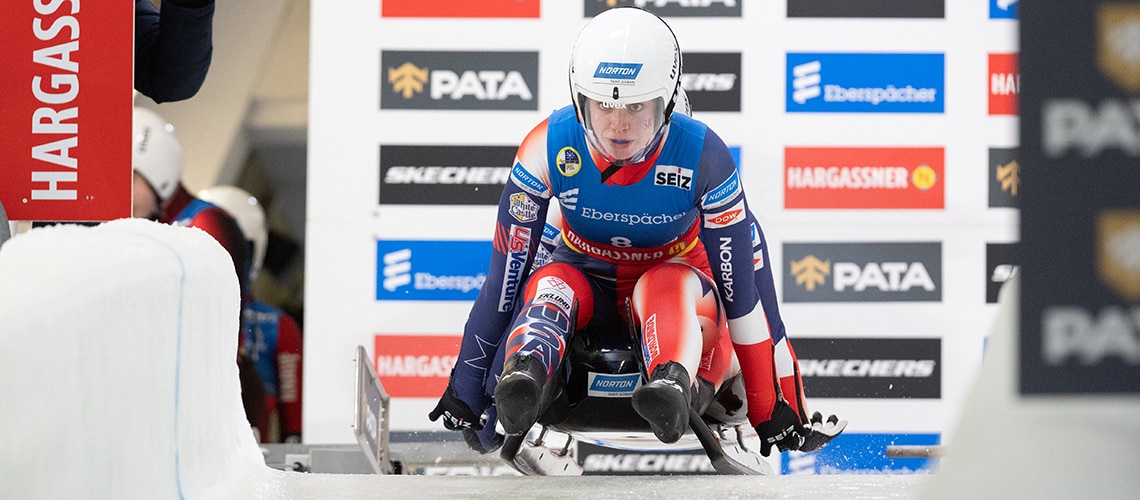
Since 2007, Dow and USA Luge—one of Dow’s long-standing sports partnerships —have been transforming how the team’s sleds are designed, tested and raced. Our Materials Engineering Center (MEC) has leveraged state-of-the-art R&D tools like 3D printing, custom testing and pressure-mapping technology, alongside Dow’s deep expertise in mobility elements like Noise, Vibration and Harshness (NVH), to help USA Luge secure more than 100 World Cup and World Championship medals and achieve historic podium finishes. And not only has this collaboration resulted in success on the track, but it’s also strengthened Dow’s capabilities.
Within our MobilityScience™ sector, Dow works to optimize the ability of automotive components to withstand elements like thermal cycling and mechanical stress, all while aiming to reduce component weight. This is parallel to the challenges we seek to address when it comes to luge sleds. So, by collaborating in real time with USA Luge, we’ve been able to push the needle on top-tier athletic performance while bringing our learnings back to a design table based on a similar foundation, which has helped us further develop innovative mobility solutions like advanced acoustic-dampening materials for vehicles. The relationship between innovation in luge and innovation in automotive is symbiotic. What we learn in either space helps the other.
To shed some light on the science of sports and the innovation at the heart of luge, I sat down with USA Luge’s Jon Owen, USA Luge Technical Project Manager.
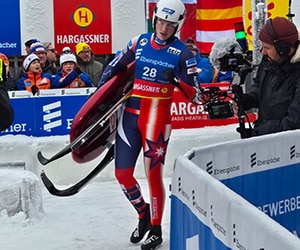 Dow’s materials have introduced a new level of precision to luge sled design and sports engineering. Understanding materials, their properties, and the execution they bring has optimized sled performance.
For example, with their knowledge of chemistry and advanced characterization testing, alongside their expertise in NVH, Dow helped us modify the kufens (the sled blades or runners or the part of the sled that touches the ice) to improve vibration dampening without adding weight, which is critical for maintaining speed and stability. Silicones in washers and bridges also improve dampening for better fit and performance. These innovations allow us to optimize load transfer and reduce micro-vibrations, resulting in sleds that deliver consistent handling and repeatability across runs.
We’ve also tapped into Dow’s additive manufacturing capabilities to create gummy and pod molds, and 3D printed parts that help us improve efficiency in component testing.
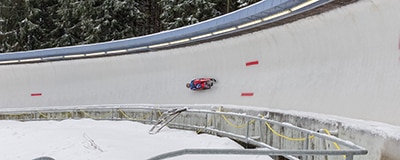 Luge has unique challenges in that we often compete in the extreme cold. Understanding how certain materials will perform under these conditions is not always well known, and that is where the analytical capability of Dow guides us to the correct material for the specific application.
Additionally, we are able to use the MEC lab to conduct real world testing that allows us to better understand how different materials will perform and work best for our athletes.
Data analytics bridges the gap between design and real-world performance. Dow developed a custom data logger that captures critical metrics during training runs, such as vibration levels and load distribution. This data supports comparisons between runs and links real-world outcomes to virtual simulations, allowing us to fine-tune sled components and configurations.
By understanding how the sled behaves under different conditions, we can make targeted adjustments that enhance control and speed for each athlete. What works for Tucker West will be vastly different than what optimization looks like for another athlete, which will be vastly different from what our Doubles teams need.
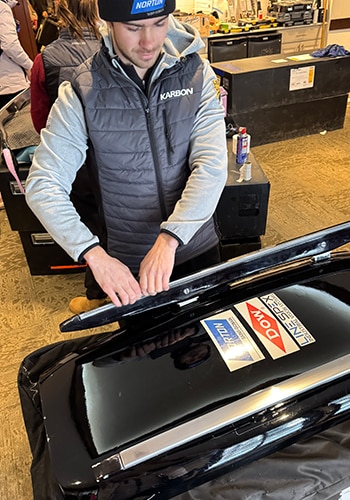
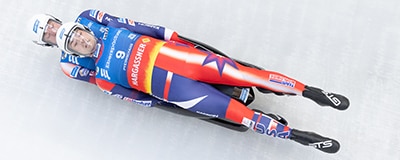 “Athlete comfort directly impacts control and consistency. Using pressure-mapping technology, we analyzed how athletes interact with the sled during runs. This data revealed pressure points and informed the design of customized padding for sled pods that replaced improvised padding like yoga mats.
When athletes feel physically secure and supported in the sled, they’re able to focus entirely on their technique and line. In short, it makes a world of difference.”
 Dow is helping us create real-world and virtual test beds, simulating entire sleds and runs virtually to verify the physics behind our parts, their durability and life cycle. These test beds will help to reduce the time and cost associated with physical prototyping.
We are also expanding the use of Finite Element Analysis and going into some very interesting areas we can’t talk about that will reap benefits at the 2030 Games.
Kevin Koepplinger is an Associate Research Scientist at Dow and the technical lead for Dow’s partnership with USA Luge. As a key member of Dow’s Materials Engineering Center team, Kevin is responsible for innovating, testing and improving Dow’s materials science for high-growth markets such as packaging, infrastructure, mobility and consumer applications.
For USA Luge specifically, Kevin has led Dow’s collaboration with the team for the past three years, translating engineering and materials expertise into real-world speed for the sliders. His work includes guiding the selection and application of high-performance Dow silicone materials for critical sled components, balancing precision engineering with the agility required in a competitive, race-driven environment, and accelerated solutions through advanced testing.
A Mid-Michigan native, Kevin earned his bachelor’s degree in mechanical engineering from Saginaw Valley State University and draws on both engineering discipline and a lifelong love of sport to help push performance in the fastest sport on ice. Kevin’s love of sport carries over into his free time as well, where he supports his two daughters in their many athletic endeavors.
Jon Owen is the Technical Project Manager for USA Luge. A former Olympian, Jon brings his personal experience with luge to the design table and the track, acting as the main liaison between USA Luge and the team’s technical partners – like Dow – for project management and product development.
In his role, he initiates and develops new technological processes in luge sled design and manufacturing, maps out project timelines, creates multi-partner collaborations, and facilitates communication between engineers and athletes regarding project testing and implementation.
Before he stepped into his current role, Jon was the USA Luge Junior National Team Coach & Manager as well as the Western Regional Program Coach & Manager. He also served as a Paramedic for 26 years.
Jon competed on the USA Luge Men’s Singles team at the 1988 Winter Olympics in Calgary and was a U.S. National Champion in the Men’s Singles division in 1990.
Jon has his A.S. in Emergency Medical Care from the New Hampshire Technical Institute, alongside his B.A. in Environmental Studies from the University of Utah. In his free time, he enjoys the outdoors – from skiing and white water rafting to sailing.
*This article was originally published February 02, 2026.